
Downrigger Buying Guide: Manual vs. Electric
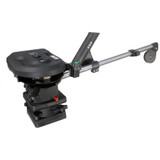
A downrigger is a simple machine: a spool of cable on a boom, a heavy weight on the end of the cable, and a release clip that carries your line down with it. The buying decision is also simple on paper — crank it yourself, or let a 12-volt motor do it. Everything else in this guide is the detail that decides which side of that line you should land on: how much weight the unit is built to lift, how fast it brings that weight back up, how far the boom reaches, what the cable is made of, and how the whole thing mounts to your boat.
The short version
- Manual downriggers cost less, weigh less, need no wiring, and ask your arm to do the lifting — one or two feet of cable per crank turn. In our catalog, manuals are a Scotty-only range, $77.99 to $386.99.
- Electric downriggers retrieve at 200-plus feet per minute with a button push, and add auto-stop and digital counters as you move up. Ours run from a $591.99 Scotty to Traxstech units over $2,000.
- Weight capacity is the spec that matters most. Match the unit to the heaviest weight you plan to run — the ratings run from under 4 lb on the smallest manual to 20 lb on the big electrics.
- Mounting is half the purchase. Some units include a swivel base; some include a clamp. Check what's in the box before you compare prices.
What we actually sell
Honesty first, because it shapes this guide: our downrigger range is 17 complete units. Seven manuals and seven electrics from Scotty, one electric from Cisco, and two electrics from Traxstech. That's a real range — it covers every price band below — but it's not every brand on the market. Cannon is the name many buyers start with, and we don't currently stock Cannon downriggers; Cannon shows up in our catalog only as a bolt pattern, on the Cisco adapter plate that lets a Cannon-base unit sit on Cisco mounts. Everything compared below is gear we sell and can stand behind.
Manual vs. electric: the real trade
A manual downrigger is a crank, a spool, a clutch brake, and a depth counter. Scotty's manuals retrieve one foot of cable per turn of the spool on the Depthmaster models, two feet per turn on the faster Strongarm and Longarm spools. Do the arithmetic once and you'll know whether manual suits you: a weight sitting 100 feet down is 50 to 100 turns of the handle to bring back up, against the drag of the weight itself. For occasional use with lighter weights, that's a chore measured in seconds. Done repeatedly, all day, with a 10 or 12 lb weight, it's the reason electric downriggers exist.
An electric replaces the crank with a 12-volt motor. You gain push-button retrieve, controlled descent, and — on most of our electrics — an auto-stop that halts the weight at the surface on its own. You also gain an installation job: each unit needs its own wired run back to the battery with a fuse or breaker (Traxstech specifies a 30-amp fuse and 10-gauge wire for runs up to 15 feet), and it draws on the boat's battery every time it lifts. Scotty's electrics include the plug and receptacle in the box; the wiring back to the battery is on you.
Neither type is more "serious" than the other. They're the same machine with different labor arrangements, at very different prices — the most expensive manual we sell costs about $200 less than the cheapest electric.
Retrieve rate: cranks per foot vs. feet per minute
Manuals are rated in feet per turn, electrics in feet per minute under load — and the load matters, because every electric slows as the weight goes up. Scotty's Depthpower electrics lift a 7 lb weight at 235 feet per minute and a 15 lb weight at 203. The High Performance models are quicker: 260 feet per minute with a 20 lb weight. Traxstech publishes tested figures for its Elite series — 265 feet per minute at 12 lb, 240 at 14 lb, and 200 at 20 lb. Cisco doesn't publish a feet-per-minute figure for its downrigger; it rates the motor by the weights it retrieves, up to 20 lb.
The practical reading: the electrics with published rates bring a weight up from 100 feet in roughly half a minute or less. A manual brings it up when you've finished cranking. If you reset your gear a handful of times in a trip, that difference is minor. If you reset constantly, it compounds.
Weight capacity: buy for the heaviest weight you'll run
Every downrigger is built around a working weight range, and it's the first spec to check — a unit run above its range wears its clutch, spool, or motor doing work it wasn't sized for. Scotty publishes capacity bands by family, and our range covers all of them:
- Under 4 lb: the Laketroller manuals — small-boat units with 100 feet of cable.
- 7–10 lb: the Depthmaster and Depthking manuals, the classic 23″-boom compacts.
- 10–12 lb: the Strongarm and Longarm manuals, with bigger booms and faster spools.
- 7–15 lb: the Depthpower electrics.
- 12–20 lb: the High Performance electrics, Cisco's telescopic-boom unit, and Traxstech's Elite series (tested retrieving a 20 lb weight).
If your fishing tops out at a 10 lb weight, a mid-range manual or a standard Depthpower covers you with room to spare. The 20 lb class exists for heavier weights — you don't need it until you do, and buying it "just in case" costs real money.
Boom length
Booms in our range run from 12 inches on the Laketrollers to 60 inches on Scotty's telescoping models; Cisco's boom telescopes from 3 to 6 feet. A longer boom moves the cable farther out from the hull and the transom, and spreads multiple downriggers farther apart. A shorter boom is easier to reach, easier to store, and puts less leverage on the mount. Telescoping booms split the difference — full reach when extended, collapsed to 36 inches for storage — and they're the standard layout on mid-range electrics and up. Traxstech builds its Elite on a solid aluminum boom with optional lengths, rather than a telescoping one.
Cable: stainless steel vs. braid
Most downriggers ship spooled with stainless steel cable — 150 lb test on most Scotty manuals and standard electrics, 180 lb on the High Performance models, and 400 feet of 150 lb-test 316 stainless on the Traxstech Elite. Stainless is the default for a reason: it's proven, it's consistent on the depth counter, and replacement spools are cheap (a 200 ft Scotty stainless cable is $26.99). Its weaknesses are physical: wire kinks, frays strand by strand over time, and needs inspecting.
Braid — a microfilament line in the 200 lb class — is the alternative, and two of our Scotty electrics ship with it: the 1106-B with 300 feet of 200 lb braid, and the 2106B with 300 feet of 250 lb braid. Braid is thinner for its strength, which means less drag in the water, and it doesn't kink or fray the way wire does; it can, however, wear at the spool and the pulley, and it costs more to replace (a 200 ft Scotty Premium Power Braid spool is $34.99). Either material swaps onto most spools later, so treat the factory spooling as a starting point, not a life sentence.
Mounting: the half of the purchase people forget
A downrigger is only as solid as what it bolts to, and what's included varies enough to change what a unit really costs:
- Included mounts. Scotty's manuals include a deck bracket, a side/deck mount, or a clamp mount, depending on the model — the clamp and portable-bracket versions suit boats that won't take permanent hardware. Scotty's electrics step up to a tilt-up bracket plus the 1026 swivel pedestal mount, which indexes through 16 positions. Cisco's downrigger includes its swivel base, and Traxstech's includes an aluminum swivel base with 12 locking positions.
- Swivel bases let you turn the boom inboard — worth having on any unit that lives on the boat, and the first upgrade we'd add to a unit that lacks one (the Scotty 1026 pedestal on its own is $82.99).
- Track mounting. If your boat already runs a 3″ track system, the Scotty 2650 Downrigger Track Mount ($69.99) puts most Scotty downriggers on the track — the Laketrollers are the exception. Cisco's mounts cover the same ground their way: a track mount from $36.95, a Quick Release Mount from $97.95 that lifts the unit off its gunnel plate in seconds, and a gimbal mount that uses an existing flush-mount rod holder socket. Which track fits which accessory is its own rabbit hole — we covered it in Track Compatibility Explained.
- Pedestal risers raise the unit off the gunwale when clearance demands it; both Scotty and Cisco sell them in several heights. Buy them only if your layout needs the height — they're a clearance fix, not an upgrade.
Rod holders: check the count before you compare prices
Most downriggers carry the rod for the line they're lowering, and the holder situation differs by model. The Laketrollers include no rod holder at all. Scotty's other manuals and its standard electrics include a single boom-mounted Rodmaster II; the Propack and High Performance dual models carry two holders, as do Cisco's unit (two tube holders on repositionable mounts) and Traxstech's (dual rotating holders — the MacDaddy package swaps in two GTLT-100 ratcheting holders). A "cheaper" unit with no holder isn't cheaper once you've bought the holder.
Representative models, our October 2026 prices
| Model | Type | Boom | Cable / line | Retrieve | Rod holder | Price |
|---|---|---|---|---|---|---|
| Scotty 1073 Laketroller | Manual | 12″ | 100 ft, 150 lb stainless | 1 ft per turn | None | $77.99 |
| Scotty 1050 Depthmaster | Manual | 23″ | 200 ft, 150 lb stainless | 1 ft per turn | Single | $180.99 |
| Scotty 1091 Longarm Combo | Manual | 36–60″ telescoping | 200 ft, 150 lb stainless | 2 ft per turn | Single | $386.99 |
| Scotty 1101 Depthpower | Electric | 30″ | 250 ft, 150 lb stainless | 203 ft/min at 15 lb | Single | $591.99 |
| Scotty 2106 HP Depthpower | Electric | 36–60″ telescoping | 300 ft, 180 lb stainless | 260 ft/min at 20 lb | Single | $828.99 |
| Cisco Telescopic Boom | Electric | 36–72″ telescoping | Not published on the product page | Not published; motor rated to 20 lb | Dual | $1,089.95 |
| Traxstech Downrigger Elite (DRES-400) | Electric | Solid aluminum, optional lengths | 400 ft, 150 lb-test stainless | 200 ft/min at 20 lb | Dual | From $1,769.95 |
The bands tell the story: manuals $78–$387, Scotty electrics $592–$906, then a step up to the machined-aluminum electrics from Cisco ($1,089.95) and Traxstech ($1,769.95 in silver, $2,085.95 in black; the MacDaddy package runs $2,095.05–$2,359.95). What the step up buys is construction and controls — Cisco machines its downrigger from solid aluminum with an all-metal pulley and clutch; Traxstech adds a lighted keypad, programmable depth memory, and an electronic counter. Whether that's worth two to three times a Scotty electric is a budget question, not a quality verdict — the Scottys are proven, long-warranted machines.
So which one?
Buy a manual if your weights run light, your trips are occasional, and you'd rather not wire the boat: a Depthmaster-class manual is a complete, durable answer for under $200. Buy an electric if you run heavier weights, reset often, or simply don't want the cranking — the Depthpower class is the value center of the electric range. Buy the 20 lb class only when your weights actually get there. And buy the mount with the same care as the unit: a swivel base and a solid foundation matter more to daily use than a few feet per minute of retrieve speed.
If you're building the boat around one maker's track system as well, our Traxstech vs. Cisco comparison covers how the two ecosystems stack up beyond downriggers. Browse the full range here: All downriggers · Scotty · Cisco · Traxstech
A note on prices and specs: Prices in this post are our store prices as of the date above and can change without notice — the linked product page always shows the current price. We check specifications and compatibility against the manufacturer's information when we write each post, but manufacturers can change products without notice, so confirm the details on the product page before you order.