
Traxstech vs. Cisco: Which Track System Should You Build Your Boat Around?
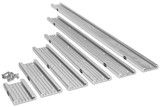
We sell both. Traxstech and Cisco are the two names every trolling angler lands on when they're ready to mount rod holders on a track system, and the question we hear most is simple: which one?
The honest answer is that they're closer than the forum arguments suggest — close enough that plenty of boats run both. But they're not identical, and the differences that matter aren't the ones most people shop on. Here's how we'd walk through it.
The short version
- Tracks: nearly identical in price and concept. Cisco includes end stops and mounting hardware. Both offer a center cut-out on long tracks — built into Traxstech's 60″ and 72″, an option on Cisco's 60″, 72″ and 83″.
- Rod holders: both lift-and-turn. Traxstech ratchets the angle (17 positions); Cisco indexes the rotation on machined teeth (20 positions) and levers the angle.
- Trees: Traxstech's post is fixed and side-specific; Cisco's whole mast rotates at the base so you can swing it inboard.
- Price: building the same boat both ways came out $88 apart on a ~$1,150 build at our prices (math below) — close enough that price shouldn't decide it.
- Compatibility: both follow the same 3″ track channel standard, and mixed setups are common — with a couple of practical caveats.
First, the question everyone asks: can you mix them?
Mostly, yes. Both systems are built around the grooved aluminum track standard that traces back to Bert's Custom Tackle, established in 1989 — Bert's developed the aluminum-extrusion version of an earlier tracking idea, and its 3″ × ¼″ channel is still the pattern accessories slide into and lock down. Cisco says it outright on its track page: their tracks are compatible with equipment from any brand offering that channel. Traxstech doesn't publish a cross-brand statement, but owner reports are consistent that the dimensions match and mixed-brand setups are everywhere.
Two practical caveats:
- Loading style. Most accessories slide in from the end of the track. On a long track loaded with gear, that means unloading in sequence to reach the middle — unless the track has a center cut-out. Traxstech builds the cut-out into its 60″ and 72″ tracks standard; Cisco offers it as an option on its 60″, 72″ and 83″ tracks, and also sells a Drop & Lock mount that drops straight in.
- Locking hardware feels different — Traxstech uses star-shaped thumb screws, Cisco uses solid aluminum knurled knobs. Different feel, same job.
Bottom line: pick your track on the track's merits. You're not locking yourself out of the other brand's accessories.
The tracks
Both are anodized aluminum, both come in lengths from a few inches to six feet and beyond (Cisco goes to 83″ and does custom lengths). At our prices they're nearly a coin flip: a 48″ Traxstech track is $112.95, a 48″ Cisco Sure-Stop is $107.95, and at 72″ they're dead even at $204.95.
Where they differ:
- Cisco Sure-Stop tracks come standard with threaded end stops at every corner, so gear can't slide off the end while you're running — and the stops double as thumbscrew points. Mounting hardware is included, and Cisco machines a small access incline into the open track edges.
- Traxstech sells end caps separately, but its track inserts deserve a mention: slide your gear out and a Starboard insert fills the channel flush, so the gunwale is clean when the boat is doing non-fishing duty.
The rod holders
This is where the two brands genuinely part ways — not in quality, but in mechanism.
Traxstech's GTLT-100 ratchets its angle: 17 fishable positions, adjusted one-handed with a big release knob, while the Lift & Turn base handles 360° rotation. Their RH1 is the simpler lift-and-turn holder at $124.95.
Cisco's tube holders (the single tube runs $118.95 without a mount; $138.95 on a track mount) index their rotation: lift the tube and it locks into 20 machined-tooth positions around the full circle, while a padded lever sets the angle anywhere from 0–90°.
Which is "better" is a hand-feel question. If you change rod angles constantly, the Traxstech ratchet is satisfying. If you want the holder locked at a precise rotation and rarely touch the angle, Cisco's teeth feel more set-and-forget. Both are machined aluminum, both carry lifetime-class warranties, and neither uses plastic in the parts that matter.
The trees
Trees show the clearest design split:
- Traxstech's Vertical Bird Trees (VBT-2 $289.95, VBT-3 $389.95, VBT-4 $489.95) use a fixed post sold in dedicated port and starboard versions. Each holder adjusts independently — six locking positions across 90° — but the tree itself doesn't rotate.
- Cisco's Indexable Tree Mast ($431.95 with three holders) puts the adjustment in the base: pick the mast up and rotate the whole tree inline with the boat for docking and trailering. Holders clamp onto the mast and can be repositioned vertically and radially — nothing is welded in place.
If your trees live on the boat full-time, the Traxstech approach is simple and solid. If you're constantly swinging gear inboard to dock or trailer, Cisco's rotating mast solves a real annoyance.
What the same boat costs in each system
Same shopping list, both brands, our October 2026 prices:
| Traxstech | Cisco | |
|---|---|---|
| Two 48″ tracks | $225.90 | $215.90 |
| Four single rod holders | $499.80 (RH1) | $555.80 (Single Tube, track mount) |
| Three-holder tree | $389.95 (VBT-3) | $431.95 (Indexable Tree) |
| Total | $1,115.65 | $1,203.65 |
$88 on an $1,100-plus build. Price is still not the reason to choose between these two — anyone who tells you otherwise is selling something. (Us included, technically. But we sell both.)
The differences that actually decide it
- Planer gear depth: Cisco goes deeper — planer masts, electric planer reels, clutch kits. Traxstech answers with planer board caddies for its trees, but if planer systems are your centerpiece, Cisco's catalog is broader.
- Colors: Traxstech offers silver or black in its textured Signature Finish across the line. Cisco adds bright gold and blue tube options. (One owner note that comes up repeatedly: black anodizing shows sliding wear more than silver — true of both brands.)
- Boat-specific mounts: both make mounts for factory gunwale track systems — Traxstech has brackets for Tracker and Alumacraft factory tracks; we stock Cisco mounts for Lund Pro Trak and Tracker VersaTrack as well.
- Downriggers: both companies now build their own electric downriggers, so either ecosystem keeps you in one brand if you want that.
- How it's made and shipped: Traxstech machines and hand-assembles in Chesaning, Michigan, and sells from stock. Cisco builds to order in Ohio — their site quotes 8–14 business days for production. Both are made in the USA. If you need it this week, that lead time matters; if you're rigging in February for April, it doesn't.
So which one?
If you adjust rod angles all day and want your gear shipped from stock, lean Traxstech. If you want a tree that swings inboard, planer-system depth, or set-and-forget indexed holders, lean Cisco. And if you already own one brand's track — keep it, and buy whichever brand makes the specific accessory you want. The standard is shared; the loyalty doesn't have to be.
Browse both lines here: Traxstech · Cisco · All rod holders
A note on prices and specs: Prices in this post are our store prices as of the date above and can change without notice — the linked product page always shows the current price. We check specifications and compatibility against the manufacturer's information when we write each post, but manufacturers can change products without notice, so confirm the details on the product page before you order.