
Cisco Planer Systems: Masts, Reels, and Clutch Kits Explained
In our complete planer-board setup checklist, we treated the planer system as a whole: boards, releases, shockers, tow line, rod holders, and the mast and reels that run the tow line. This post zooms in on the drive end for a buyer who has already landed on Cisco — because Cisco's planer lineup, read cold, looks like a pile of overlapping aluminum: complete masts, mast-only poles, bare reels, complete drive reels, motors, clutches, pulleys, and clamps.
Those aren't competing products. They're layers of one system, sold at different levels of assembly. If the brand decision itself is still open, start with Traxstech vs. Cisco. This post answers a narrower question: once it's Cisco, which pieces do you need, what does each one do, and what does a complete setup cost?
The short version
- A complete mast is the default buy. Cisco's complete masts bundle the mast, drive reel(s), line guides, variable clutches, pulleys, and a removable base in one product.
- Single vs. dual means one reel or two — one tow line or two, run from the same post. Cisco's drive reels have no port/starboard designation; a dual mast isn't a left-and-right pair, it's two independent reels on one mast.
- Mast-only is a custom route, not a budget route. A mast-only pole plus a separate drive reel costs more than the equivalent complete mast. It buys placement freedom and the 8″ reel option, not savings.
- 6″ vs. 8″ is a line-capacity choice, not a power upgrade.
- The clutch is a friction system, and its wear parts come in a $31.95 kit — the cheap spare to carry.
The system, in four parts
A Cisco planer setup is four jobs:
- The base anchors the mast — either a track mount that slides into a track system or a bolted 5″×6″ base.
- The mast gets a pulley up high, so the tow line leaves the boat at height and runs out to the board.
- The drive reel stores the tow line, pays it out, and retrieves it — by hand on a manual reel, by a 12-volt motor on an electric.
- The clutch sits between you (or the motor) and the reel and controls how much load the reel holds before it slips — the shock absorber in the drive train.
Everything Cisco sells in this line is one of those four jobs, a part of one, or an accessory supporting one.
Complete masts: the bundled route
Cisco's complete masts — the full range is in Cisco Planer Systems — are built on a solid 1½″ mast and include machined aluminum reels, line guides, variable clutches, aluminum clutch knobs, aluminum-cased pulleys with sealed stainless bearings, and a removable base (revolving handles included on the manual reels). Heights run 4′, 5′, 6′, and 8′.
Here are the four families, each in the same configuration — 6′ mast, non-Break-Away, track and 5″×6″ versions priced the same:
| Complete mast (6′ configuration) | Price |
|---|---|
| Cisco Single Manual Planer Mast (PMSGM) | $539.95 |
| Cisco Dual Manual Planer Mast (PMDMM) | $742.95 |
| Cisco Single Electric Planer Mast (PMSGE) | $676.95 |
| Cisco Dual Electric Planer Mast (PMDBE) | $947.95 |
The 4′ manual versions start at $528.95 (single) and $699.95 (dual); height adds a little as you go up. The duals also offer a Break-Away version that splits the mast in two to clear bridges, garages, and overhead lines — on the 6′ dual manual it raises the mast to $1,024.95, so it's a clearance solution, not a casual upgrade.
Track mount or 5″×6″ base?
This is where the track decision from post #1 reaches into the mast purchase:
- Track mount slides into most track systems and locks down, so the mast can be repositioned or removed and the track can carry other gear the rest of the day. It assumes you already have track — the track itself isn't part of the mast price.
- The 5″×6″ traditional base is the dedicated mount: the listing includes an aluminum backing plate, gunnel plates, and a removable 4″×5″ plate, so the mast comes off while the base stays bolted. Pick this when there's no track where the mast needs to live.
The mast-only route: separate reels, your layout
Cisco's Planer Mast with Pulley(s) (PMSRT) is the mast without the drive: mounting base, solid collar, and swivel pulley included; no reel. Sizes run from 12″ up to 6′, with the same base choice and a single- or double-pulley option, at $179.95–$565.95 depending on configuration. It's built for rigging Cisco's manual or electric reels onto a mast height and position of your choosing, including spots a full-size mast won't fit.
This is where buyers most often misread the catalog, because Cisco sells the word "reel" at three different levels:
- The bare reel. Cisco's 6″ and 8″ Aluminum Reels (XPREL) — $108.95 for the 6″, $211.95 for the 8″ — are the machined aluminum reel itself: 7/16″ bore, four bronze clutch pads, no shaft, bracket, handle, or motor, and a revolving handle sold separately. This is a component, not a drive unit.
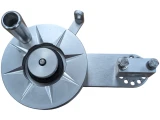
- The complete manual drive reel. Cisco's Manual Planer Reel (from $312.95) is the working unit: 6″ or 8″ reel, variable clutch, aluminum clutch knob, aluminum revolving handle, universal mounting bracket, line guide, and vee clamps. The bracket's mounting plate has 14 tapped hole locations and the bracket and line guide adjust into 12 positions, so the reel clamps to a rail, hardtop pipe, or mast at the angle the line needs. A manual reel can also be upgraded to electric later by adding a separate planer motor.
- The complete electric drive reel. Cisco's Electric Planer Reel (from $427.95) is the same idea with a high-torque motor in place of the handle. Its listing states plainly that the electric control is sold separately — remember that at the electric build below.
Those base prices use the standard vee clamps (7/8″–1½″ rails); large vee (1½″–3″) and low-profile clamps cost more, and replacement clamp sets start at $39.95.
Now the honest math. Build a 6′ manual single from parts: mast-only with single pulley, $511.95, plus one complete manual drive reel, $312.95 — $824.90 before line, against $539.95 for the complete Single Manual Mast with the reel already on it. The separate route makes sense for a custom mounting location, a short mast, an 8″ reel, or a reel clamped somewhere other than a mast. Not as a way to save money.
6″ or 8″ reels: it's about line capacity
Cisco's published capacities, from the reel listings:
| Reel | Approx. 500# line | Approx. 800# line |
|---|---|---|
| 6″ reel | 300 ft | 225 ft |
| 8″ high-capacity reel | 500 ft | 400 ft |
That's the whole decision. If the tow line you run fits the 6″ — and a standard 200′ spool of 500# line does — the 6″ is the reel. The 8″ earns its price when you run longer or heavier line. The complete masts are built around the 6″; the 8″ choice lives on the separate drive-reel route.
How the clutch works — and what's in the kit
The clutch is a friction stack on the reel shaft. The solid aluminum clutch knob screws down and loads three Belleville washers — dished springs — which press a pressure plate against the reel's friction surfaces, with a drive pin tying the assembly to the shaft. Tighten the knob and the reel holds more load before it slips; back it off and it gives line more readily. That controlled slip is the point: when a board surges in waves, the clutch absorbs the spike instead of the mast, the line, or the motor taking it all at once.
The friction surfaces are the wear parts, and Cisco sells them as one Clutch Kit for Planer Reels (XPCRK) at $31.95. The full contents, per the listing:
- 1/8″ stainless steel drive pin
- Pressure plate
- 3 stainless steel Belleville washers
- 4 bronze clutch pads
- UHMW drag washer
- O-ring for the manual planer-reel shaft
Cisco's own pitch is the honest one: it's nice to have spare pieces around in case of a dropped or lost item. At $31.95 against a lost day on the water, we agree. Also worth carrying: a spare aluminum revolving handle ($26.95), which Cisco recommends electric-reel owners keep aboard in case of a power or wiring failure. A replacement aluminum clutch knob by itself is $21.95.
Pulleys, support, and the line retriever
Pulleys. The pulley at the top of the mast is what the tow line turns on. Cisco's are aluminum-cased: solid aluminum side plates, a hard-anodized sheave recessed so the line can't slip between sheave and side plate, sealed stainless bearings, and a 12/0 swivel rated at 1,500 lb. Complete masts and the mast-only pole include their pulley(s). The standalone Cisco Single Planer Pulley (from $89.95) is for rail- and hardtop-mounted rigging, with clamps for 7/8″–3″ pipe and extension standoffs from 3″ to 10″ to set pulley height.
Support. A tall mast under a hard-pulling board is a lever working on its base. Cisco's Planer Mast Support Collar ($66.95) slides over the 1½″ pole, locks with four set screws, and gives you a tie point for support lines, spreading the load on the base. The support line itself isn't included.
Risers — a naming caution. Cisco's riser mounts are made for single rod holders and electronics mounts; no riser is listed as a planer-mast option. On a mast, height is chosen in the mast itself (4′–8′ on complete masts) — don't plan a build around stacking a rod-holder riser under one.
The line retriever. Cisco's Planer Board Line Retriever (MTPBR) ($115.95) is a 360° swivel cam cleat on a standard track mount. Working with a separate rope and carabiner clip — neither included — it pulls the tow line in tight against the gunwale and holds it there, keeping the line clear of rod tips and out from under reels, which matters most in tight turns, one-handed. Despite the name it doesn't retrieve the board; it's line management, and it's optional.
Three complete Cisco builds
All three use the 6′ mast, the non-Break-Away version, and Amish Outfitters Planer Board Line — 500# test, 200′ spool, $28.95 — one spool per reel. Each mast price includes its reel(s), clutch(es), line guide(s), pulley(s), and base. Boards, shockers, and releases are deliberately not in these totals: they're the board end of the system, priced in full in the checklist in post #2. Rod holders and track are likewise excluded — they depend on the boat. Totals exclude tax and shipping.
Level 1 — Manual single
| Cisco Single Manual Planer Mast, 6′ | $539.95 |
| Amish Outfitters Planer Board Line, 500#, 200′ × 1 | $28.95 |
| Total | $568.90 |
One tow line, cranked by hand — the mast from post #2's build, priced here with the tow line separate instead of inside the board package.
Level 2 — Manual dual
| Cisco Dual Manual Planer Mast, 6′ | $742.95 |
| Amish Outfitters Planer Board Line, 500#, 200′ × 2 | $57.90 |
| Total | $800.85 |
Both sides from one post, still hand-cranked. The $231.95 step up from Level 1 is the real price of the second side: reel, clutch, and line.
Level 3 — Electric dual (mast-and-line hardware)
| Cisco Dual Electric Planer Mast, 6′ | $947.95 |
| Amish Outfitters Planer Board Line, 500#, 200′ × 2 | $57.90 |
| Total | $1,005.85 |
Powered retrieval on both sides. One honest caveat before treating that as an all-in figure: the complete-mast listing doesn't specify what control and wiring is included, and Cisco's separate electric-reel listing states the control is sold separately. Confirm the control and wiring arrangement for your boat before ordering. The spare revolving handle ($26.95) is also not in this total.
The bottom line
Buy the complete mast unless you have a specific reason not to. Manual single if you run one side, manual dual if you run two, electric if you'd rather push a switch than crank — the single comes in electric too, at $676.95 in the 6′ configuration above. Take the mast-only route only when the boat dictates it: an unusual mounting spot, a short mast, or a genuine need for the 8″ reel's capacity. And whichever route you take, put the $31.95 clutch kit in the boat — the cheapest part of the system, and the one most likely to be needed away from the dock.
Browse: Cisco Planer Systems · Cisco
A note on prices and specs: Prices in this post are our store prices as of the date above and can change without notice — the linked product page always shows the current price. We check specifications and compatibility against the manufacturer's information when we write each post, but manufacturers can change products without notice, so confirm the details on the product page before you order.