
Rod Holder Trees vs. Individual Holders: Which Layout for Your Boat?
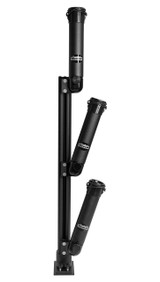
Once you've picked a track system — we compared the two big ones in Traxstech vs. Cisco — the next question is layout. Do you stack three or four rod holders on a single vertical post, or spread individual holders along the track?
Both layouts catch the same fish. They differ in how much gunwale they use, how much freedom you have to move things around, what they cost per rod, and what happens when it's time to dock, trailer, or put the boat away. Here's how we'd walk through it.
The short version
- Space: a tree puts 2–4 holders on one mounting point and stacks them vertically. Individual holders each take their own spot along the track.
- Flexibility: individual holders move, spread out, or come off one at a time. A tree moves as a unit — its holders stay in their cluster.
- Cost per rod: closer than you'd expect. At three rods, a tree costs slightly more than three singles from the same brand. At four rods, it costs slightly less. The math is below.
- Docking and storage: Cisco's tree mast rotates inboard at the base; Traxstech's post is fixed. Singles come off the track one by one and store flat.
- The honest answer for a lot of boats is both: trees where gunwale space is tight, singles where you want to spread out.
What each layout actually is
A tree is a vertical post that mounts at one point on your track and carries several holders at staggered heights. Traxstech's Vertical Bird Trees come in two-, three-, and four-holder versions — posts about 16″, 29″, and 39″ tall respectively, before the top holder. Cisco's Indexable Tree Mast is a 36″ mast with three holders that clamp on and can be repositioned up, down, and around it — and you can add a fourth tree holder to the same mast (Cisco recommends two to four holders per mast).
Individual holders are one rod per base. Traxstech's RH1 at $124.95 and Cisco's Single Tube (from $118.95, $138.95 with the track mount) each slide into the track wherever you put them. Premium singles like Traxstech's ratcheting GTLT-100 at $199.95 are their own decision — we covered the mechanism differences in the brand comparison linked above.
Gunwale space: the tree's real argument
A tree's strongest case isn't price. It's footprint.
Three individual holders need three mounting spots spread along your track, plus working room around each one. A tree needs one mounting point. Traxstech recommends a track section of 24″ or longer under a vertical tree — the longer the section, the more strength and stability — but that same section is then free for everything else you run on it, instead of being parceled out holder by holder.
That matters most amidships. A tree parked forward leaves the stern corners and the rest of the gunwale open for downriggers, a net, or just moving around the boat. If your track run is short, or already crowded, stacking vertically buys you positions you don't have horizontally.
The trade: what's vertical takes up air instead. A four-holder Traxstech tree stands about 39″ of post, plus roughly another 10″ if the top holder sits upright. That's clearance to think about under a bridge, in a garage, or under a boat cover — and it's all in one place, where three singles would each sit low along the rail.
If you're still sorting out track itself — lengths, mounting, what fits what — that's the whole subject of track compatibility explained.
Flexibility: singles win, and it isn't close
Individual holders are Lego. Slide one six inches. Pull one off and put a downrigger in its place. Run two today and four next weekend. Each holder adjusts on its own, sits where you want it, and comes off without disturbing the others.
A tree is a fixed cluster by design. The whole unit moves along the track, but the holders travel together. Within the cluster, how much adjustment you get depends on the brand:
- Cisco's mast is the flexible tree. Its holders aren't welded — they clamp to the mast and can be repositioned vertically and radially, and staggered so a lower rod clears the one above it.
- Traxstech's post is fixed, and the tree itself doesn't rotate. Adjustment lives in each holder: six locking positions across 90°, independently per holder.
One more point for singles: they can borrow a tree's main trick. Cisco sells risers that raise an individual tube holder's height, so a row of singles doesn't have to sit at one level. It costs extra per holder, but it means "staggered heights" isn't a tree exclusive.
Docking, trailering, and putting the boat away
This is where the layouts feel most different day to day.
Cisco's indexable base answers the tree's biggest annoyance directly: pick the mast up, rotate it inline with the boat, and all the holders swing inboard — inside the boat's outline for dock posts and trailering, instead of sticking up and out at the rail.
Traxstech's tree doesn't rotate. If it's in the way at the dock, the whole tree slides out of the track as one unit — simple, but now you're storing a post that's 16″ to 39″ tall depending on the model.
Singles are the easiest to live with here. Each one slides out on its own, they store flat in a compartment, and the empty track takes a flush insert (Traxstech sells Starboard ones) so the gunwale is clean when the boat is doing non-fishing duty. The flip side: three or four singles are three or four separate pieces to remove, keep track of, and put back.
What each layout costs per rod
Same brands both ways, our October 2026 prices, silver finish, track-mounted where there's a choice. One layout, one side of the boat:
| 3 rod positions | Total | Per rod |
|---|---|---|
| Traxstech tree (VBT-3) | $389.95 | $129.98 |
| Traxstech singles (3 × RH1) | $374.85 | $124.95 |
| Cisco tree (Indexable, 3 holders) | $431.95 | $143.98 |
| Cisco singles (3 × Single Tube, track mount) | $416.85 | $138.95 |
| 4 rod positions | Total | Per rod |
|---|---|---|
| Traxstech tree (VBT-4) | $489.95 | $122.49 |
| Traxstech singles (4 × RH1) | $499.80 | $124.95 |
| Cisco tree (Indexable + 1 extra tree holder) | $528.90 | $132.23 |
| Cisco singles (4 × Single Tube, track mount) | $555.80 | $138.95 |
Read that table twice, because it surprises people: a tree is not the budget option. At three rods, both brands' trees cost about $15 more than their own singles. At four rods the tree edges ahead — by about $10 on the Traxstech side, about $27 on the Cisco side. Real money, but not decision money. You're buying a layout, not a discount.
Two honest footnotes. First, Cisco's tube holder starts at $118.95 without a mount; the $138.95 track-mount version is the fair comparison here, and it's what we used. Second, swap the value singles for premium ones — four GTLT-100s at $199.95 are $799.80 — and the arithmetic flips hard toward trees. What singles you choose matters more than which layout you choose.
The layout a lot of boats actually end up with: both
Nothing says a boat picks one. A common rig is a tree amidships on each side — where gunwale space is tightest and stacking pays — plus individual holders at the stern corners, where spreading out is easy and the holders double for other duty. Per side, at our October 2026 prices, that's a VBT-3 at $389.95 plus one RH1 at $124.95: $514.90 for four positions, two of them flexible.
It also lets you buy in stages. Singles first, because they're the flexible default. Add a tree later on the same track if you run out of rail — the track standard doesn't care, and neither do we.
So which layout?
- Short track run, crowded gunwales, or you want positions amidships without giving up the stern: lean tree.
- You reposition gear often, run different setups on different days, or want the gunwale clear in minutes: lean individual holders.
- You dock in tight quarters or trailer with the gear on: Cisco's rotating mast is the one feature here that solves a daily problem outright.
- You're pricing it out: run the per-rod math on the specific holders you actually want. Layout changes the total less than holder choice does.
Browse both layouts here: Traxstech · Cisco · All rod holders
A note on prices and specs: Prices in this post are our store prices as of the date above and can change without notice — the linked product page always shows the current price. We check specifications and compatibility against the manufacturer's information when we write each post, but manufacturers can change products without notice, so confirm the details on the product page before you order.