
Trolling Motor Sizing: Thrust and Shaft Length by Boat Size
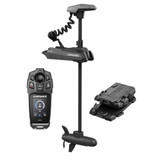
Most trolling motor mistakes are measurement mistakes. People shop by boat length alone, pick a thrust number that sounds big, and never measure the one distance that decides whether the prop stays underwater: the bow, where the motor mounts, down to the waterline.
Sizing is really two separate jobs. Thrust comes from your boat's fully loaded weight — hull, motor, fuel, batteries, people, and gear, not the brochure weight. Shaft length comes from your bow height and your water conditions. Get those two measurements right and the rest of the decision — voltage, mount, controls, freshwater or saltwater — mostly sorts itself.
One disclosure before the math: every motor in our Trolling Motors category right now is a premium, GPS-equipped, bow-mount model running on 24 or 36 volts. The guidance below is brand-neutral and covers the whole market, including the smaller 12-volt and transom-mount motors we don't currently stock. Where our range doesn't fit, we'll say so.
The short version
- Thrust: Minn Kota's rule is at least 2 lbs of thrust for every 100 lbs of fully loaded boat weight. Wind and current call for more.
- Voltage follows thrust: roughly speaking, up to ~55 lbs is 12V (one battery), 70–90 lbs is 24V (two), and 112–115 lbs is 36V (three). Many modern brushless motors run on either 24V or 36V and make more thrust on 36V.
- Shaft length is measured, not guessed: start with the distance from the bow mounting surface to the waterline, and keep the center of the motor's lower unit at least 12″ below the surface.
- Freshwater and saltwater motors are not interchangeable. A freshwater motor used in saltwater can lose its warranty — Minn Kota says so outright.
- Bow-mount pulls, transom-mount pushes. Bow motors give better boat control; transom motors are simpler, cheaper, and tiller-steered.
Thrust: start with the scale, not the sticker
Thrust is a static measure of pushing power, not speed — Minn Kota is explicit that more thrust does not necessarily mean a faster boat. What it buys you is control: the ability to move the boat and hold it where you put it when wind or current push back.
The formula is simple:
Fully loaded weight ÷ 100 × 2 = minimum pounds of thrust
A 2,000 lb boat, loaded, needs at least 40 lbs. A 4,000 lb boat needs at least 80. Minn Kota's current Buying Guide turns that formula into a chart of common boat sizes:
| Total boat weight (loaded) | Boat length | Recommended minimum thrust | System voltage |
|---|---|---|---|
| 1,599 lbs or less | 14′ | 30–40 lbs | 12V |
| 1,600–2,599 lbs | 16′–17′ | 40–55 lbs | 12V |
| 2,600–3,599 lbs | 17′–18′ | 70–80 lbs | 24V |
| 3,600–4,599 lbs | 18′–19′ | 80–90 lbs | 24V |
| 4,600–5,599 lbs | 20′–23′ | 112–115 lbs | 36V |
| 5,600–9,999 lbs | 24′–28′ | 112–115 lbs | 36V |
| 10,000–15,000 lbs | 28′–35′ | 115 lbs | 36V |
Source: Minn Kota Trolling Motor Buying Guide (Johnson Outdoors). Minn Kota calls these general recommendations based on common boat sizes, and notes that performance can vary on large vessels and in extreme conditions.
Two things to notice. First, the chart's thrust ranges sit a little above the bare formula at some weights — that's because motors come in classes, and you round up to the next class, not down. Second, boat length is the junior partner in this table. Two 19-foot boats can be 1,500 lbs apart loaded, and the heavier one needs the next motor up. Weigh your rig the way you actually fish it.
Voltage: thrust decides how many batteries
Voltage isn't a feature to shop for its own sake — it's what the thrust you need requires. Minn Kota's rule is one battery for every 12 volts in the system: a 12V motor runs on one battery, 24V on two, 36V on three. Their thrust guide maps the classes like this: 55 lbs of thrust or less is 12V territory; 70–90 lbs is 24V; 112–115 lbs is 36V.
The wrinkle is modern brushless motors. The premium lines — including everything we currently stock — are mostly dual-voltage: the same motor runs on a 24V or a 36V bank and simply makes more thrust on 36V. That changes the buying question from "which voltage is this motor?" to "which bank do I want to build?" A 36V setup costs a third battery, the space to put it, and a charger that handles three — but on a dual-voltage motor it unlocks the top thrust rating, and the motor works less hard for the same push. If your boat's minimum lands near the top of a motor's 24V rating, that's the honest argument for building the 36V bank now instead of re-rigging later.
Shaft length: measure the bow, then add for your water
A shaft that's too short lets the prop break the surface in chop — it cavitates, gets loud, and loses its bite exactly when conditions are worst. Minn Kota's baseline is that the center of the motor section should sit at least 12″ under water. Work from your actual measurement:
- Measure from the bow mounting surface to the waterline, with the boat loaded the way you fish it.
- Rough water: Minn Kota says add 5″ to that measurement before choosing. Garmin's guidance for its Force line says add 8″ if you regularly fish in sizable waves. Use the method from the maker of the motor you're buying — don't stack both.
- Hand-control bow motors: add another 9″ (Minn Kota), because the head has to reach you, not just the water.
Manufacturers publish model-specific charts because shaft geometry differs by mount. As a concrete example, Simrad's sizing rule for the RECON is clean arithmetic: bow height plus 20″ is your minimum shaft — so a 54″ RECON fits a bow up to 34″ above the water, a 60″ up to 40″, and a 72″ up to 52″.
A longer shaft is not automatically better. It has to stow flat on your deck, clear your cover, and not drag bottom in the shallows you fish. Buy the shortest shaft that satisfies your maker's chart for your worst normal conditions — not your calmest day, and not a once-a-year storm either.
Bow-mount or transom-mount?
Minn Kota's reasoning is physics: boats don't travel in a straight line, it's easier to pull a boat than push one, and the bow is easier to move sideways than the stern. So a bow-mount gives you the finer control, and it's where the GPS anchoring, remotes, and display integration live.
Transom-mount motors clamp to the back, steer with a tiller, and are the right answer for smaller boats, dinghies, and canoes that don't need — or can't fit — a bow installation. They're also where the lower thrust classes and 12V systems live. As of this writing our category is bow-mount only, so if your boat wants a transom motor or a small 12V unit, that's a gap in our range, not a reason to buy the wrong motor.
Freshwater vs. saltwater: buy for the harshest water you'll run
This is the one place a wrong choice costs you warranty coverage. Minn Kota states plainly that using a freshwater motor in saltwater may dramatically shorten its life and voids the manufacturer's warranty. Saltwater models — Minn Kota's Riptide line is the reference example — are built differently on purpose: stainless hardware, sealed electrical connections, encapsulated electronics, and an advanced coating process for corrosion protection.
If you fish brackish water, that's saltwater for sizing purposes. And a saltwater motor still needs care: Minn Kota's guidance is to rinse it with freshwater after every saltwater use, store it indoors, and never leave it submerged while the boat is moored. What you can't do is rinse a freshwater motor and call it converted — the protection is built in at the factory or it isn't there.
Controls: cable, electric, pedal, remote, display
Steering style is the last decision, and it's about how the motor takes orders:
- Cable-steer uses a physical cable between the foot pedal and the motor. Minn Kota describes these as rugged and responsive, with the most direct feel — the pedal and the motor are mechanically linked.
- Electric-steer turns the motor with a steering motor instead. That electronic link is what makes wireless remotes, GPS anchor modes, and display control possible. Every motor we currently stock is electric-steer.
- Foot pedals come in both worlds. On a cable-steer motor the pedal is the steering. On electric-steer motors the pedal is one controller among several — Lowrance's Ghost X, for example, uses fly-by-wire steering that's built to feel like cable-steer without physical cables to wear out, and Garmin's Force pedal is wireless and can also be hard-wired.
- Handheld remotes free you from the bow. The Recon's FreeSteer remote is a joystick that jogs the boat's anchor point in eight directions; Garmin's Force remote steers by point-and-go gesture. Check what's in the box: on the freshwater Recon, the wireless foot pedal is included with the remote; on the saltwater versions, the remote is the included controller.
- Chartplotter control is the third layer on networked systems: a compatible display can steer the motor, run routes, and anchor from the helm over NMEA 2000. It's genuinely useful, but it's brand-ecosystem territory — a Lowrance motor pairs with Lowrance/Simrad displays, a Garmin motor with Garmin. Buy the motor that matches the electronics you run, or budget for the display too.
What we actually carry
Our Trolling Motors category held twelve motors when we wrote this — four premium lines, all bow-mount, all 24/36V dual-voltage. Six are freshwater models and six are saltwater. Honest summary: if your sizing math lands on 24V or 36V and a 47″ or longer shaft, we probably have a fit. If it lands on 12V, a transom mount, or a short shaft for a small boat, we currently don't.
| Model | Water | Shafts (our prices) | Power and control |
|---|---|---|---|
| Lowrance Recon FW | Freshwater | 48″ $3,669.99 · 54″ $3,724.99 · 60″ $3,774.99 · 72″ $3,979.99 | 115 lbs at 36V / 90 lbs at 24V (Lowrance's current spec). FreeSteer joystick remote and wireless foot pedal included, HDI sonar nosecone |
| Lowrance Recon SW | Saltwater | 54″ $3,874.99 · 60″ $3,979.99 · 72″ $4,179.99 | 24/36V brushless, FreeSteer joystick remote included |
| Simrad RECON SW | Saltwater | 54″ $3,874.99 · 60″ $3,979.99 · 72″ $4,179.99 | Same RECON platform for Simrad displays, 24/36V, FreeSteer joystick remote included |
| Lowrance Ghost X | Freshwater | 47″ $3,979.99 | 24/36V fly-by-wire, foot pedal and Active Imaging 3-in-1 nosecone included, GPS remote optional; Lowrance rates it at 20% more thrust than the original Ghost |
| Garmin Force | Freshwater | 57″ $2,482.99 | 100 lbs at 36V / 80 lbs at 24V (Garmin, per ISO 13342). Wireless foot pedal and gesture remote included, built-in sonar |
Run your two numbers — loaded weight and bow height — against the tables above before you fall for any row in this one. And once the motor's picked, the mounts, brackets, and rigging pieces live in Trolling Motor Accessories.
A note on prices and specs: Prices in this post are our store prices as of the date above and can change without notice — the linked product page always shows the current price. We check specifications and compatibility against the manufacturer's information when we write each post, but manufacturers can change products without notice, so confirm the details on the product page before you order.