
Flasher vs. Camera vs. Sonar for Ice Fishing: What Each One Actually Does
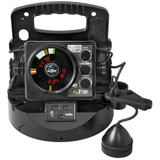
Three different devices get sold as if they do the same job: show you what's under the ice. They don't. A flasher, an underwater camera, and a digital sonar unit each show you a different thing, in a different way, with different blind spots — and the newer fourth option, live sonar, is different again.
None of them is "best." They answer different questions. Here's what each one actually does, mechanically, and what it can't do.
The short version
- Flasher: sonar shown as a real-time dial. No picture, no history — just what's in the cone right now, color-coded by signal strength. One sealed unit, transducer, and battery. The simplest, most portable of the three.
- Camera: actual video. You see the fish, the bottom, and your lure as they really look — but only as far as the water is clear and there's light to see by. It tells you nothing outside the camera's view.
- Digital sonar: the same sonar idea as a flasher, drawn on a screen as a scrolling 2D picture with history. Most also have a built-in flasher view, and many add GPS. More information, more menus, more to carry and power.
- Live sonar: real-time sonar images you can point — down under the hole, or forward out to a distance. The most information, and by a wide margin the most money and the most gear.
- Price at our store, October 2026: a digital sonar bundle starts at $215.99, flashers run $355.99–$699.99, complete camera systems $288.99–$599.99, and a complete live-sonar ice bundle is $2,851.99. Details below.
First, the question everyone asks: do I need more than one?
They're not substitutes, and plenty of people do run two — a sonar device for depth and marks, a camera for a look at what's actually down there. But each one has a blind spot the others cover:
- A flasher or sonar cannot tell you what a mark is. It shows a return at a depth. It can't show you species, size in any reliable way, or whether that return is a fish at all.
- A camera cannot tell you depth or distance beyond what its cable markings show, and it sees nothing outside its lens. If the fish is ten feet to the left, the camera doesn't know.
- Neither a flasher nor a conventional sonar shows you direction. Everything they show is inside the transducer cone under the hole. Forward-looking live sonar is the exception — that's its whole point.
Bottom line: pick based on which question you actually want answered — "is something under me right now," "what does it actually look like down there," or "what's around me, and where."
The flasher
A flasher is sonar with the simplest possible display. The transducer sends sound down; returns come back; the unit lights them up around a circular dial, top of the dial at the surface, bottom of the dial at your set depth range. Vexilar's own manual puts the difference plainly: a graph builds a history, while a flasher's data "always represents the current point in time" — real time, nothing saved, nothing scrolled.
Colors are signal strength, not decoration. On a Vexilar, green is a weak return (a small lure, weeds, a target at the edge of the cone), yellow/orange is medium, and red is strong — bottom, or a target right in the center of the cone. That's the whole picture, and it's enough if the question is "what's in the cone, at what depth, right now."
What you get, gear-wise:
- One self-contained pack. Vexilar's systems ship as a case with the flasher, a floating Ice-Ducer transducer, and a 12-volt battery with charger — the Pro Pack II is built to fit in a five-gallon bucket. Our Vexilar range runs from the FL-8SE Genz Pack at $355.99 and the FLX-12 Pro Pack II at $434.99 up to the FLX-28 Pro Pack II at $599.99, which adds auto-ranging, a digital depth readout, and five color palettes.
- No history, no GPS, no picture. If you look away, what happened is gone. It doesn't mark spots, and it doesn't work as a boat unit the way a dual-purpose sonar can.
- Low power draw and nothing to update. There's no screen drawing a graph and no software. It's a dial, a battery, and a transducer.
The camera
An underwater camera is exactly what it sounds like: a camera on a long cable, lowered through the hole, feeding a live picture to a screen. No interpretation layer — you see the bottom type, the cover, and any fish that come into view, as they actually look. That's information no sonar of any price can give you.
The limits are physical, and they're the deciding factor:
- Water clarity. The camera sees as far as the water lets light travel. In clear water that's a real view; in stained or dirty water it can shrink to almost nothing. Sonar doesn't care — sound works in water you can't see an inch into.
- Light. It's dark under ice and snow cover. Camera systems use built-in lights, including infrared on many models, which helps at close range — IR extends what you can see in low light, it doesn't fix murky water.
- The cable is the range finder. Depth is read off cable markings, and the camera only looks where it's pointed. Some systems include a direction indicator; many require turning the cable by hand (or an add-on panner) to change the view.
What we stock shows the two forms: the Aqua-Vu AV822 HD is a complete system — 1080p camera, 60 feet of cable, its own 8″ screen, recording, and a rechargeable battery Aqua-Vu rates at 9 hours — at $599.99. At the other end, the Vexilar Fish-Scout Base Camp is $288.99, has a 50-foot cable and an HDMI output, and the monitor is not included — it's built to plug into a TV or monitor you supply. Read camera listings carefully on that point; "camera system" doesn't always mean "screen included."
A camera has no transducer cone and shows no depth column. It answers "what is that, exactly" better than anything else here, and "where is everything" worst of all.
The digital sonar
A modern digital sonar unit — a fishfinder — uses the same return idea as a flasher and draws it differently: a scrolling 2D picture that moves across the screen, so what happened a minute ago is still visible on the left while new returns appear on the right. That history is the whole difference. CHIRP sonar sweeps a range of frequencies instead of pinging one, which the makers use for clearer separation between close-together returns.
Two things blur the old flasher-vs-sonar line:
- Most digital units include a flasher view. Humminbird's ICE HELIX line, for example, can split the screen between a digital flasher display and the 2D history view. Garmin's units offer a real-time A-scope/flasher mode alongside the scrolling graph. You're often choosing a display preference, not two different technologies.
- Many add GPS. Waypoints and mapping are things a dedicated flasher simply doesn't have. If that matters — or if you want one unit that can also go on the boat in summer with a different transducer — that's the digital sonar's argument.
Our most direct example is the Garmin STRIKER 4 Portable Bundle at $215.99: a 3.5″ CHIRP unit with GPS, a scrolling display with sonar-history rewind, a built-in flasher mode, and a portable case with a rechargeable battery and a transducer float — Garmin sells it for kayak, canoe, and ice use alike. One honest note: its included transducer is a general dual-beam transducer on a float, not a dedicated ice transducer. Garmin's dedicated Dual Beam-IF Ice Transducer is $82.99 on its own, and ice transducers are built to hang straight and still in a hole. Our fishfinder category covers the wider range of units; dedicated ice-sonar packs from the boat brands come and go in our catalog, so check the category for current stock.
The fourth option: live sonar
Live sonar (Garmin LiveScope, Humminbird MEGA Live, Lowrance ActiveTarget) is real-time sonar imaging: instead of a dial or a scrolling graph, the screen shows a live picture of returns that updates as things move, and the transducer can be aimed. Garmin's LiveScope Plus offers two modes from one transducer — Down, a live view under the ice, and Forward, which Garmin rates out to 200 feet in any direction. That's the one capability nothing above has: seeing distance and direction, not just the cone under the hole.
The costs are real, in money and in gear:
- It's a system, not a unit. Garmin's LiveScope Plus Ice Fishing System at $1,555.99 is the transducer, the GLS 10 sonar module, and a pole mount — you add your own compatible Garmin chartplotter and a battery. The complete version we carry, the ECHOMAP UHD2 93sv LiveScope Plus Ice Fishing Bundle, with the 9″ display and a lithium battery included, is $2,851.99.
- More parts, more power, more weight. A display, a separate sonar module, a pole-mounted transducer, and a battery big enough to run all of it — versus a flasher's one case. (Fun catalog quirk: our store files these Garmin ice bundles in the Ice Flashers category, alongside the Vexilars. They are not flashers.)
We're treating live sonar as a brief fourth category here rather than a co-equal option, because at our prices it costs roughly five times a top-end flasher — it's a different purchase, not a tiebreaker.
What examples cost in each type
One representative example per type, our October 2026 prices:
| Type | Example at our store | Price |
|---|---|---|
| Digital sonar | Garmin STRIKER 4 Portable Bundle | $215.99 |
| Camera (screen not included) | Vexilar Fish-Scout Base Camp | $288.99 |
| Flasher | Vexilar FL-8SE Genz Pack | $355.99 |
| Flasher, top of our range | Vexilar FLX-28 Pro Pack II | $599.99 |
| Camera (complete, with screen) | Aqua-Vu AV822 HD | $599.99 |
| Live sonar (add display + battery) | Garmin LiveScope Plus Ice Fishing System | $1,555.99 |
| Live sonar (complete bundle) | Garmin ECHOMAP UHD2 93sv LiveScope Plus Ice Bundle | $2,851.99 |
Note where the overlap is: a complete camera and a top flasher are the same money. Those two are the real either/or decision for most people; sonar-under-$300 and live-sonar-over-$1,500 are different budgets entirely.
The differences that actually decide it
- Battery and power: a flasher pack is one 12-volt battery running one dial — the lightest power load here. Digital sonar adds a lit color screen and GPS to the same basic battery setup. A camera runs a screen plus lights. Live sonar runs a large display plus a separate sonar module, and is sold around bigger lithium batteries for a reason.
- Portability: moving hole to hole favors the fewest parts — a flasher pack is a bucket, a camera is a unit plus a cable to wind and unwind at every stop (Aqua-Vu's reel-style cable management exists because of this), and live sonar is a pole, a module, a display, and a battery to set up each time. In a permanent house, where nothing moves, that math flips — the bigger screen and the multi-part system stop being a penalty.
- Water clarity: only the camera cares. If your water is stained, sonar of any type keeps working at full range and the camera's view shrinks. If your water is clear, the camera shows you things sonar can't.
- What you look at all day: a dial in real time, a scrolling graph you can glance back at, an actual video picture, or a live image you can aim. This is a preference, not a spec — but it's the thing you'll live with, so it should probably outrank the feature list.
- Open-water use: digital sonar and live sonar systems are built to cross over to the boat. A dedicated flasher and most ice cameras are ice-only purchases. If the budget has to work in July too, that narrows the field fast.
So which one?
If you want the lightest, simplest answer to "what's under this hole, right now," in any water clarity — a flasher. If you want to see what things actually look like down there and your water runs clear — a camera, ideally alongside something that reads depth. If you want history on the screen, GPS, and a unit that can earn its keep on the boat in summer — digital sonar. And if you want to see out around the hole, in real time, and the budget is genuinely there — live sonar.
What we'd skip: buying a camera as your only electronics if you fish stained water, and buying live sonar as a first unit before you know which of the simpler questions you actually ask on the ice.
Browse the lines here: Ice flashers & ice sonar systems · Fishfinders · Vexilar · Garmin
A note on prices and specs: Prices in this post are our store prices as of the date above and can change without notice — the linked product page always shows the current price. We check specifications and compatibility against the manufacturer's information when we write each post, but manufacturers can change products without notice, so confirm the details on the product page before you order.